



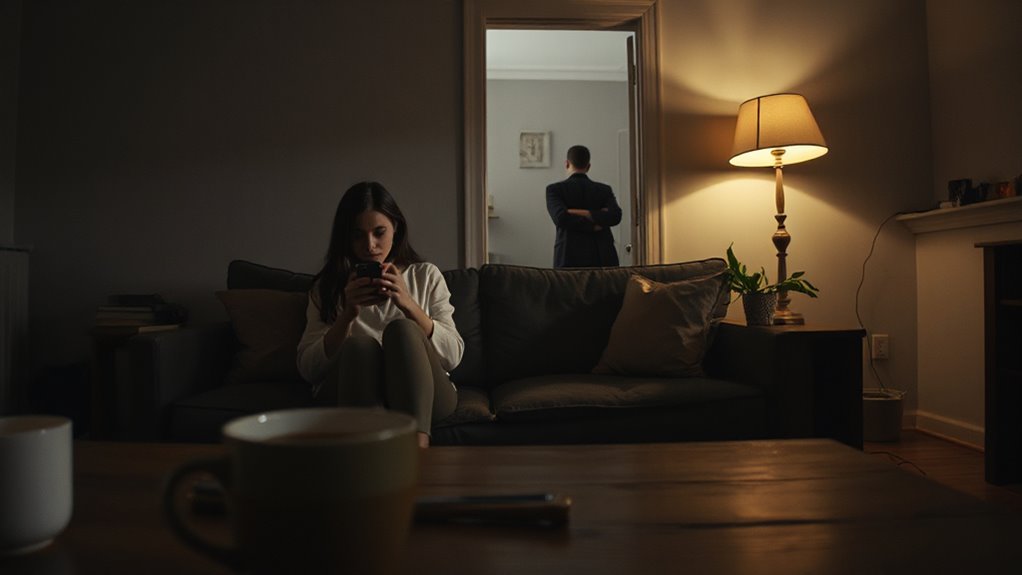
What Relationship Anxiety Actually Looks Like
Relationship anxiety does not always announce itself clearly. It hides behind constant worry, nagging doubt, and that uneasy feeling that something is about to go wrong—even when everything looks fine. Self-awareness can help you notice these patterns early and respond more intentionally.
A person might fear abandonment without real evidence, question their partner’s feelings despite steady commitment, or struggle to enjoy good moments because their brain keeps bracing for impact.
Reassurance helps briefly, then the doubt creeps back. That cycle is the tell.
The anxiety is not responding to actual problems. It is responding to fear, which means the relationship itself is not the issue. The person’s mind is.
Relationship anxiety is extremely common, and many people experience it even within stable, long-term relationships where no genuine threat to the connection exists.
Past relationship traumas, personal insecurities, and attachment styles formed in childhood can all quietly shape the way a person feels and reacts within their current relationship.
Behaviors That Signal Your Anxiety Is Running the Relationship
When anxiety moves in, it does not just sit quietly in the corner—it starts making decisions. Checking phones. Demanding reassurance daily. Reading silence as rejection.
These are not personality quirks; they are anxiety calling the shots. Trust rebuilds requires consistent, honest actions over time, not speeches or promises.
The pattern is usually the same: discomfort spikes, a controlling behavior eases it temporarily, then the fear returns stronger.
Jealousy flares over neutral moments. Rules multiply. Questions repeat.
Some people go the other direction entirely, withdrawing and swallowing needs to avoid conflict.
Both roads lead somewhere bad.
If the relationship is bending itself around anxiety instead of honesty, that is worth paying attention to. Research tracking couples daily found that wives’ anxiety levels were directly tied to how both partners perceived the quality of their relationship on the same day.
The non-anxious partner carries a weight that rarely gets named, as constant reassurance-seeking can strain their mental health by creating a felt responsibility for managing someone else’s fear.
How Relationship Anxiety Slowly Pushes Your Partner Away
Anxiety does not just damage the person carrying it—it chips away at the person standing next to them, too.
Constant reassurance demands exhaust partners fast.
Testing behaviors confuse them.
Push-pull cycles make emotional safety feel impossible.
Over time, a partner stops feeling like a lover and starts feeling like a therapist who never clocks out.
That wears people down.
Research consistently links attachment anxiety to lower relationship satisfaction for both people involved.
Partners do not leave all at once.
They quietly pull back, inch by inch, until the distance feels normal.
Anxiety did not protect the relationship.
It hollowed it out.
Reassurance seeking strengthens brain connections that link relief to the act of asking, making the cycle progressively harder to break. the reassurance cycle grows more entrenched with every repetition.
Each check of a read receipt or rapid follow-up message functions as a safety behavior, providing short-term relief while keeping the underlying fear alive and well-fed.
Attachment anxiety also alters neurochemistry, increasing oxytocin dysregulation during clingy behaviors and changing how trust and bonding form over time.
Do You Need Therapy for Relationship Anxiety?
How does someone know when anxiety has crossed the line from normal nerves into something that actually needs professional help? Simple. When it starts wrecking everything else.
Sleep gone. Work slipping. Friendships fading. If self-help strategies haven’t budged the pattern after several weeks, that’s a signal worth taking seriously.
When sleep, work, and friendships all start slipping, that’s not just stress. That’s a signal worth taking seriously.
Frequent conflict, emotional exhaustion, and repeated relationship strain aren’t minor anymore. Evidence shows that therapy increases chances of improving relationship outcomes by 75%.
Rapid weight loss or severe panic symptoms mean prompt support, not next month.
Thoughts of self-harm or feeling detached from reality require urgent help, full stop.
Therapy, particularly CBT or attachment-focused approaches, gives people actual tools instead of just white-knuckling through it. Research consistently shows CBT is as effective as anxiolytic medication for most anxiety disorders, meaning the pattern can genuinely be unlearned rather than just managed.
A qualified clinician can also assess whether what’s showing up is relationship-focused anxiety, obsessive-compulsive symptoms, or a trauma response, since those patterns can look similar but call for different approaches.