








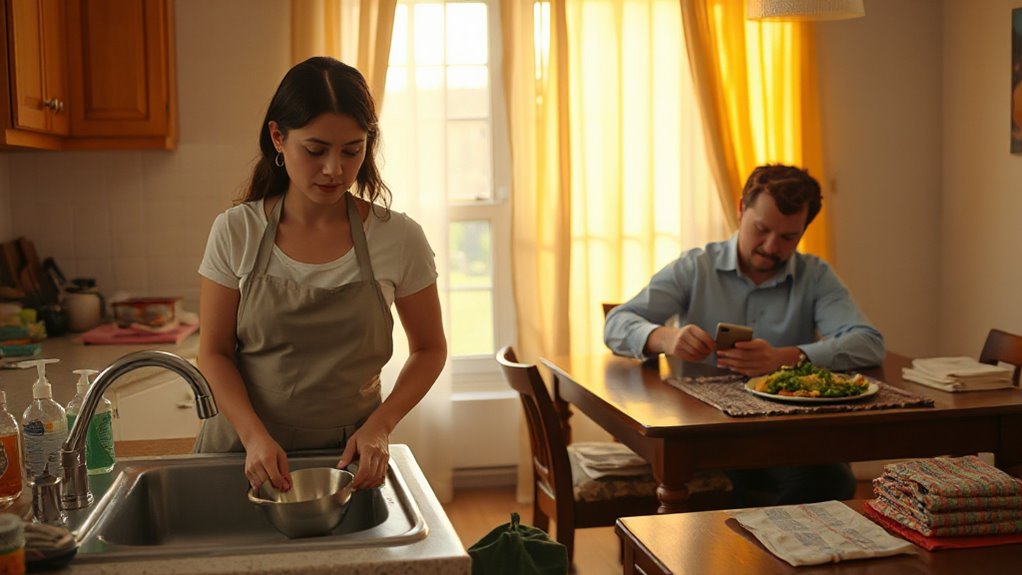
What Women in Traditional Households Are Actually Agreeing To
When a woman agrees to a traditional household arrangement, she is not just agreeing to do a few extra chores.
She is agreeing to own the daily, recurring labor—cooking, cleaning, laundry, meal prep—while he handles the occasional yard work or oil change.
Notice the difference in frequency.
Notice the difference in frequency. One list resets daily. The other resets never.
His tasks happen sometimes.
Hers happen every single day.
And even when chores are technically “shared,” she often still manages whether things get done, when, and how well.
That is unpaid project management on top of the actual work.
The arrangement sounds simple.
The fine print is considerably heavier.
Research from Poland found that even when women contribute more income to the household, traditional gender attitudes eliminate any link between that income contribution and a more equal division of housework.
Married mothers also report doing significantly more housework than never-married and divorced mothers, even after controlling for employment, number of children, and other key factors.
Many women enter these arrangements while still recovering from prior relationship dynamics and may not be fully prepared to negotiate boundaries during that time, so it’s important to consider emotional readiness.
Why Traditional Men Still Leave Housework to Women
Despite years of shifting public attitudes, the gap in housework between men and women in traditional households has not closed—it has just become easier to ignore.
Studies show men in different-sex couples handle roughly 40% of housework, sometimes less. Women average nearly 19 hours weekly while men clock around 8.5.
Traditional gender norms still quietly assign cleaning, cooking, and laundry to women by default.
Experimental research confirmed that a person’s gender alone shapes who gets held responsible for household tasks. Attitudes changed. Behavior largely did not. Men became more comfortable with the idea of equality without actually doing more.
Early patterns of unequal division can be an early warning sign that broader relationship dynamics may be unbalanced.
The Mental Load of Housework That Never Appears on Any List
There is a version of housework that never shows up on any chore chart, and it is exhausting the women who carry it.
Nobody sees the mental work of tracking supplies, timing routines, and preventing problems before they happen.
Research calls this cognitive labor, and it is a separate burden from actually doing the task.
Cognitive labor is not the doing. It is the constant thinking that makes the doing possible.
Women handle roughly 73% of it.
That number is not a typo.
This invisible planning runs constantly in the background, like a browser with too many open tabs.
And unlike dishes, it never gets finished.
Nobody ever checks it off.
The study measured this division across 30 common household tasks, asking participants to rate both the planning and execution sides of each one separately.
It shows up as higher rates of depression, stress, and burnout, with cognitive labor linked to worse relationship functioning as well.
Many women also report that emotional labor tied to household management compounds the burden and affects long-term relationship satisfaction.
How Kids Make the Housework Gap Even Worse
The mental load never really pauses, but parenthood hits the accelerator hard.
Children do not split the housework evenly—they multiply it, then dump most of that increase on mothers.
After the first birth, the gap widens fast.
Mothers handle 79% of daily jobs like cleaning and childcare, while fathers manage 37%.
Even in households where both parents work full time, mothers still log more hours on chores and child care combined.
Scheduling, sick days, school logistics—that invisible coordination lands mostly on her.
A study of 3000 U.S.-based parents found that mothers handled 71% of cognitive tasks—the mental effort of scheduling, planning, and keeping track of everything that keeps a family running.
When a child gets sick, mothers take off work nearly twice as often as fathers do.
Kids do not create equality.
They just make the existing inequality harder to ignore.
This dynamic is reinforced by persistent social norms that influence how couples divide domestic labor.
Why Housework Inequality Persists Even When Both Partners Want Change
Wanting equality and actually living it are two very different things.
Both partners can genuinely believe in fairness and still wake up five years later with the same lopsided split.
Why? Because good intentions don’t build systems.
Routines established early calcify fast.
One partner keeps mentally tracking everything—the lists, the logistics, the follow-through—while the other just *helps*.
Renegotiating that takes energy, and that labor usually falls on the same person already doing more.
Add unequal incomes and workplace pressure, and fairness talk stays exactly that: talk.
Wanting change isn’t enough.
Research tracking couples from age 25 to 50 found that gaps established early showed no signs of closing across decades.
Studies show that stereotypical gender practices in housework directly influence experiences of stress and perceived wellbeing for both women and men.
Change needs actual structure behind it.
Early patterns often persist because of communication breakdowns and passive acceptance that prevent timely renegotiation.