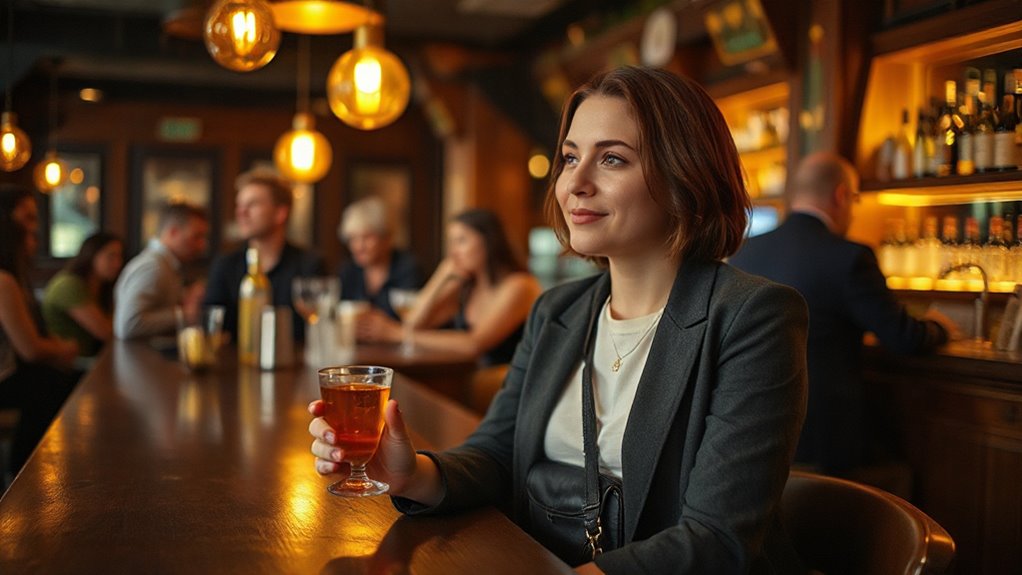
Choose the Right Bar to Visit Alone
Where you drink alone matters more than most people admit. Skip the loud Saturday-night party spot.
Nobody wants to stand exposed in a crowd. Pick a friendly tavern, neighborhood pub, or hotel bar instead. Dive bars and beer bars work too.
Look for a clear bar area, not a dining room, and grab a corner or end seat. Music, games, or TVs give you something to focus on besides your phone. Choose a spot with a counter facing the action so you always have something to watch and someone to talk to.
Regulars are a good sign. So is a bartender who actually talks.
Go early, before the rush, and read the room first. Hotel bars are an especially good starting point because transient workers and business travelers make solo patrons feel far less out of place.
Lingering should feel normal, not rushed. Keep in mind that eye contact and genuine smiles can make it easier to connect if you decide to talk to someone.
Take a Bar Seat That Invites Conversation
Picking the right bar gets you through the door, but the seat decides whether anyone talks to you.
The bar gets you through the door, but the seat decides whether anyone ever talks to you.
Sit near the center, within earshot of the bartender. That’s where the banter lives. At The Prime Rib, regular bar seating is linked to camaraderie, from chatting with the bartender to talking with the couple next door.
Grab a swivel stool, so turning toward a neighbor takes no effort. At Top of the First in San Juan in 1961, swivel support let patrons change orientation to interact with the people beside them.
Stay off the far end, where chatting means leaning and straining.
Skip seats facing screens or away from the room.
Pick seats close together, not scattered.
Proximity cuts the effort.
Then settle in with an open posture and a relaxed face. People who adopt open body posture are more likely to invite conversation because they appear approachable.
A backed stool or footrest helps you linger, and lingering invites talk.
Isolation doesn’t.
Break the Ice at a Bar Alone
How do you actually start talking once you’re parked on the right stool? Keep it small.
A solo drinker should comment on what’s right there: the band, the game, the odd decor, the menu. Observations beat rehearsed lines. Contextual openers outperform scripted ones because a shared context removes the cold-start friction of talking to a stranger.
Then ask something open, like “What brings you out tonight?” or “What should I order?” Bartenders often start with a door-opening question such as “How is your day going so far?” because the answer shows how much conversation the person wants.
A specific compliment on a drink or jacket works too, followed by a question.
Keep it brief and casual. Smile, make eye contact, and listen. Text within 24 hours to show interest if you exchange numbers.
If the answer comes back short, move on.
No pushing it. The goal is opening a door, not delivering a performance.
Enjoy a Quiet Night at the Bar
Not every night out needs a conversation. Sometimes the win is a quiet hour and a decent drink.
Go early evening or on a weekday afternoon, when the room is still settling in.
Pick a laid-back neighborhood bar, not a club. Moderate noise beats dead silence.
Grab an end seat for privacy and an easy exit, or a corner if reading.
Bring a book or journal. Give the night a job.
Nobody’s watching. Order something simple, and sip slowly. Bartenders are used to solo guests, so sitting alone looks relaxed rather than lonely.
Decide on your drink at home, because ordering ahead of time removes those first awkward moments at the counter.
Little talk? That still counts as success.
Set a 45-to-60-minute window, then leave.
Simple, unhurried, low-stakes. That’s the whole plan.
You can also try low-pressure group activities like volunteering or neighborhood meetups to create more natural social opportunities and build strong social ties.
Stay Safe at a Bar Alone, Start to Finish
Going solo is fine, but going in with no plan is how a good night turns into a bad story.
A solo drinker tells someone the venue, arrival time, and departure time.
Phone charged.
Ride arranged.
Schedule your ride in advance rather than waiting around for a bus or taxi when you are ready to leave.
Then comes the drink rule: order from the bartender, watch the pour, keep it in hand.
Left it alone? Replace it.
Bags stay zipped, valuables stay home, and the seat stays near staff, not in some dim corner. If a bag comes along, wear the strap across the body with the bag in front and the opening against the body.
Unwelcome chatter gets cut short, and gut feelings get obeyed.
Strangers don’t need a home address or travel plans.
Leave while still sharp, confirm the driver and car, stick to lit streets, and text the contact until the door locks behind.
Boring? Maybe. Effective? Absolutely.
Consider using photo verification on apps if you exchange pictures with someone you met at the bar.