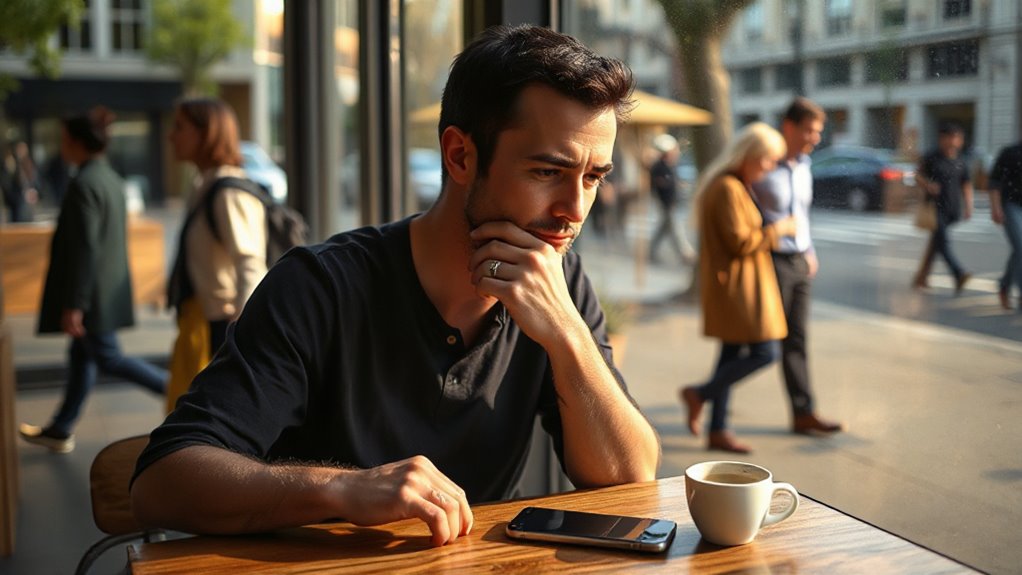




Why Uncertainty Makes Dating Feel So Hard
Dating is hard enough without the brain working against itself, but that is exactly what happens when uncertainty enters the picture.
Dating is hard enough. Uncertainty makes the brain work against you.
Studies show cortisol levels spike 45% during relational ambiguity. That is not nerves. That is a stress response.
The brain treats unclear relationship signals like a threat, cranking up anxiety and draining mental energy fast.
Sixty-two percent of people avoid initiating contact without clear commitment signals. Can anyone blame them?
Uncertainty does not just feel uncomfortable.
It actively shuts down attraction, erodes trust, and leaves people too exhausted to connect properly.
Clarity is not optional.
It is the foundation. Over 70% of singles reported feeling burned out by dating, and emotional availability has become one of the scarcest resources in modern relationships.
Intolerance of uncertainty drives constant analyzing and reassurance-seeking, turning what should be an exciting new connection into an exhausting cycle of doubt that never fully resolves. New research also shows that consistent eye contact and synchronized nonverbal cues strongly predict perceived interest, helping reduce uncertainty during early interactions.
Why Anxiety Kills Attraction Before It Even Starts
Anxiety does not just make dating uncomfortable—it actively dismantles attraction before anything real has a chance to form.
When the nervous system detects pressure as a threat, it diverts energy away from intimacy straight into survival mode.
Libido drops.
Playfulness disappears.
What replaces it? Reassurance-seeking, over-explaining, triple-texting, laughing too soon.
All of it signals insecurity instead of interest.
Putting someone on a pedestal fast creates imbalance that kills mutual attraction instantly.
Hypersensitivity turns every silence into evidence of rejection.
The nervous system is not broken—it is just misfiring.
The goal is learning to signal safety to it first.
Attraction requires space, curiosity, and the freedom to choose—none of which survive when anxious energy fills every gap.
The people who care most are often the ones who shut down fastest because a nervous system under threat activates arousal inhibition before desire ever gets a chance to surface.
Recognizing that rejection sensitivity is common and often reflects timing or compatibility rather than personal worth can help recalibrate anxious responses.
Why Your Body Treats Dating Uncertainty Like a Threat
What the nervous system does not care about is context. It does not know the difference between a lion chasing someone and a text left on read for three days.
Uncertainty registers as danger, plain and simple.
The amygdala fires within milliseconds, cortisol floods the system, and suddenly the body is preparing for a threat that does not technically exist.
Heart rate climbs. Breathing shallows. Muscles tighten.
The prefrontal cortex, the rational part, goes quiet.
The brain actually processes uncertainty with 60% higher intensity than known risks.
Waiting on someone is, biologically speaking, genuinely stressful. This is why traits like emotional stability matter so much when stress is prolonged.
That tracks.
When the nervous system is already primed for threat, even small gaps in communication, like a period instead of an exclamation point or hours without a reply, get interpreted as loss of interest.
Dating also triggers three distinct threat responses: social evaluation threat, rejection threat, and uncertainty threat, all of which send the nervous system into the same survival loop.
Why Dating Apps Are Wired to Keep You Second-Guessing Yourself
Before blaming themselves for feeling confused and insecure, people should probably take a closer look at the apps themselves.
These platforms are not built to find love. They are built to keep users swiping.
Algorithms prioritize engagement over compatibility, trapping people in cycles of mismatches and mounting rejection.
Endless profiles create cognitive overload, pushing users toward snap judgments they later regret.
Gamification mixes genuine seekers with people just chasing validation.
The result? A swamp of mixed signals, bruised self-worth, and chronic second-guessing.
The apps are not accidentally confusing.
Confusion is the product.
Users just happen to be the ones paying for it. Variable reward systems function like slot machines, delivering unpredictable matches that keep users hooked rather than helped.
The sheer volume of potential matches does not lead to better relationships but instead breeds unrealistic expectations that make real, imperfect people feel like settling.
Many users also overlook basic online safety practices that could protect their privacy and well‑being while navigating this chaotic environment.
How to Date Confidently When Uncertainty Feels Overwhelming
The good news is that dating confidently does not require eliminating uncertainty.
It requires managing the reaction to it.
Deep breathing with extended exhales calms the nervous system fast.
Pre-date routines create control where none otherwise exists.
Cognitive reframing shifts the focus from “will they like me” to “do I like them.”
That small switch matters enormously.
Preparing responses for awkward moments removes on-the-spot panic.
Starting with low-pressure dates builds confidence gradually, not overnight.
Celebrating just showing up counts.
Anxiety does not disqualify anyone from dating well.
Working with it, not against it, changes everything.
Self-compassion has been shown by research to reduce anxiety and increase resilience when navigating the challenges of dating.
Nearly everyone experiences some anxiety before dates, which means nervousness is not a personal flaw but a shared human response to vulnerability and uncertainty.
Investing in consistent self-development boosts confidence and makes those strategies more effective over time.