








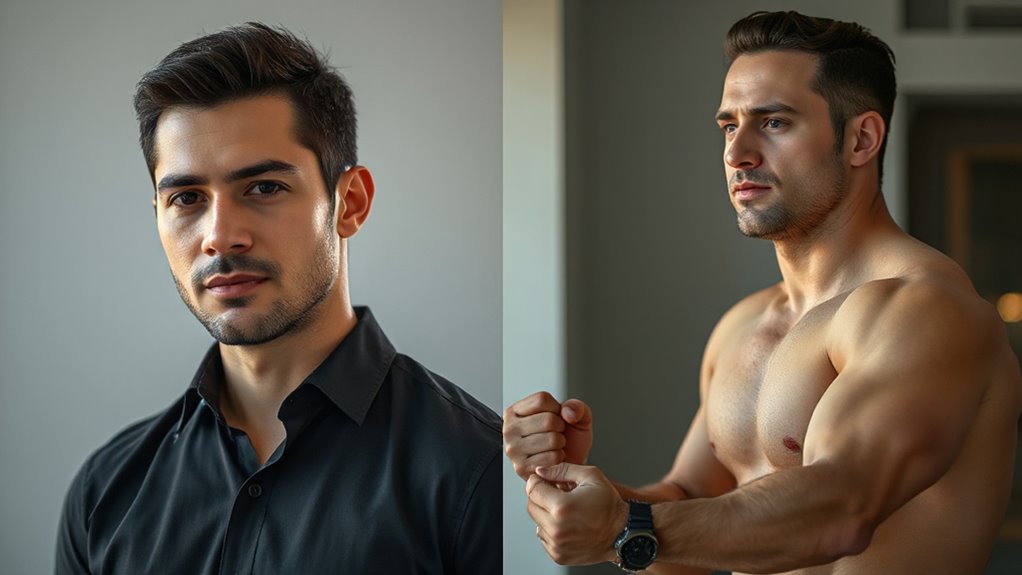
Why Upper Body Strength Determines Male Physical Attractiveness
Strip away the wishful thinking and look at the data: when 150 women rated photographs of male bodies, estimates of physical strength determined over 70% of what made those men attractive.
Not a single woman preferred weak men.
Why? Evolution doesn’t care about fairness. For thousands of years, females across mammalian species evolved to prefer the strongest males—the ones who could fight, acquire resources, and defend what mattered.
Upper body strength signals fighting ability. Wider shoulders, developed chest and arms, visible fitness: these aren’t arbitrary preferences.
They’re ancestral cues women’s brains still recognize and respond to automatically.
This pattern is also supported by research showing facial symmetry and other physiological cues consistently influence attractiveness across cultures.
How Height Influences Romantic Success and Partner Numbers
The data doesn’t lie: height matters materially in romantic outcomes, and pretending otherwise won’t help anyone.
Taller men report more sex partners, especially at the shorter end of the scale. Short men under 5’4″ face 18% lower marriage rates before 45.
Women overwhelmingly prefer men around 25 cm taller, and 60% want six-footers—but only 15% of men qualify. Dating apps amplify this ruthlessly through height filters and swiping patterns.
The gap between 5’9″ and 5’5″ creates significant attention differences. Status, charisma, and confidence can compensate, but it requires substantial effort with uncertain returns.
Kindness and emotional stability, however, often determine long-term relationship success and can mitigate the impact of height differences for many women, especially those prioritizing emotional stability.
The Body Mass Index Range That Attracts the Most Partners
Body mass index operates as a gatekeeper in romantic markets whether anyone likes it or not.
Data from over 60,000 people reveals slender women hold the most bargaining power in industrialized mating markets, racking up more partner options.
For men, the numbers tell a different story—partner counts peak at moderate BMI levels, then decline.
Women with lower BMI variance consistently outperform heavier counterparts in attracting partners.
The fitness model predicted peak attractiveness around BMI 22.8-24.8, but actual ratings favor leaner builds down to BMI 19.
Translation: lighter wins, repeatedly.
Good grooming and confident movement also reinforce these effects by signaling self-care and health.
Why Women Prefer the Mesomorphic Build Over Other Body Types
Broad shoulders paired with a tapered waist trigger reliable attraction responses in heterosexual women across cultures, and the mesomorphic build delivers exactly that combination. That V-shaped torso signals strength and athleticism without excess bulk. Women aren’t chasing softness or extreme leanness—they’re drawn to visible capability.
The mesomorph’s naturally muscular frame suggests protection, health, and genetic advantage. Unlike ectomorphs who appear fragile or endomorphs carrying excess weight, mesomorphs hit the sweet spot: solid without being heavy, strong without looking gaunt. Evolution wired this preference deep. The body type screams “I can handle physical challenges,” and that registers instantly. Self-love promotes emotional stability, which further supports healthier partner choices and attraction.
Shoulder Width and Waist Ratio: The Most Important Body Proportion
Among all the physical proportions women evaluate, shoulder width relative to waist circumference sits at the top. Research across China, Lithuania, and the UK confirms the ideal shoulder-to-waist ratio hovers around 1.57—that distinctive V-shaped torso signaling athleticism and low body fat. This ratio outperforms isolated measurements every time. When combined with height, broader shoulders amplify attractiveness dramatically. Men with larger shoulder-to-hip ratios report earlier sexual debuts and more partners throughout life, proving this dimorphic trait carries real-world romantic consequences.
Key proportion markers women unconsciously assess:
- Shoulder-to-waist ratio of 1.57 represents peak male attractiveness
- Body fat between 12-15% with BMI of 23-27 optimizes appearance
- V-shaped torso signals superior fighting ability and genetic fitness
- Broad shoulders combined with narrow waist outweigh individual features
- Ratio preferences reflect hardwired desires for metabolic health indicators
Consistent body language cues like physical proximity—such as standing closer and leaning in—often reinforce perceived attractiveness during interactions.
Which Physical Traits You Can Change to Improve Attractiveness?
Unlike bone structure or height, most physical traits that drive attraction remain within a man’s control—provided he commits to consistent effort.
Upper-body muscles matter most: shoulders, chest, arms, abs. Train them hard.
Posture signals confidence and testosterone—stand tall, move with purpose, own your space.
Skin quality beats facial structure for attractiveness; clear skin screams health and low stress. Groom deliberately.
Even voice and movement amplify appeal when purposeful.
Symmetry helps, sure, but you can’t fix that. Focus on what moves the needle: muscle, posture, skin, presence. These aren’t minor tweaks—they’re the difference between invisible and magnetic.
Small, consistent changes in exercise, sleep, and grooming build real visible vitality that others notice within weeks.