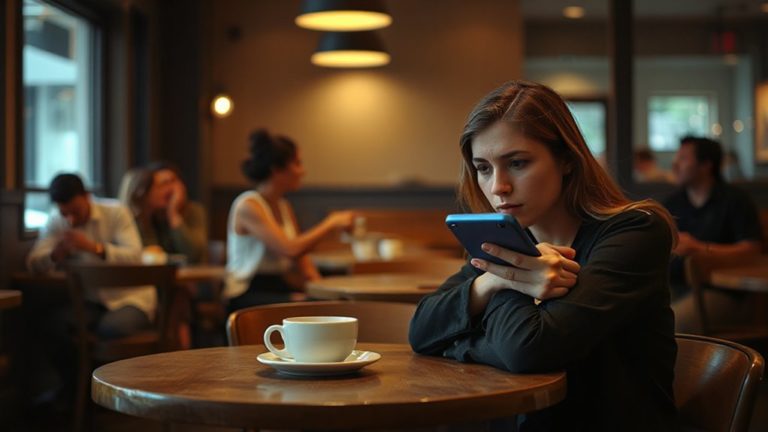




Why Loneliness Feels Worse Even When You’re Around People
Most people assume loneliness is a numbers problem—not enough people around, not enough invitations, not enough faces in the room.
They’re wrong. Loneliness is a gap problem.
It’s the distance between the connection someone needs and what they’re actually getting.
Research consistently separates loneliness from isolation because they’re not the same thing.
Loneliness and isolation are not interchangeable—research draws a clear line between the two.
Shallow interactions don’t close that gap.
They sometimes widen it.
Sitting in a crowded room, having conversations that go nowhere, leaves the brain registering a mismatch.
The contrast gets sharp fast.
Strained or surface-level relationships can actually make loneliness hurt worse than genuine solitude ever would. Loneliness causes deaths—approximately 871,000 each year—making what feels like an emotional inconvenience one of the most consequential health crises of our time.
In 2024, one in five Americans reported rarely or never receiving social or emotional support from others, signaling just how widespread this gap has become.
Building consistent positive interactions—not just more interactions—helps close that gap and foster emotional safety.
The Real Health Risks of Weak Social Ties
For a long time, loneliness got filed under emotional problems—something therapy handles, not cardiology.
Turns out, the body disagrees.
Research links social isolation to a 32% higher risk of premature death, a 29% higher risk of heart disease, and roughly a 50% higher dementia risk in older adults.
Stroke risk climbs.
Depression doubles.
Inflammatory markers rise.
The immune system takes hits.
These aren’t soft, speculative numbers—major health agencies treat weak social ties as a genuine clinical risk factor, comparable to smoking or obesity.
A pooled analysis of over 1.3 million individuals found that social isolation carries a hazard ratio of 1.33 for all-cause mortality.
Women diagnosed with breast cancer face particularly stark odds—social isolation is associated with a 51% higher risk of breast cancer mortality.
Superficial connections aren’t just unfulfilling.
They’re quietly expensive in ways most people never see coming, and lacking meaningful connections can also increase vulnerability to targeted exploitation online.
What Real Connection Actually Looks Like Versus Surface Contact?
Understanding the health toll of isolation is one thing. Knowing what genuine connection actually looks like is another.
Most people confuse familiarity with closeness. They’re not the same.
Real connection feels like emotional safety—no masks, no performance, no dread of judgment.
Conversation flows without forcing it.
Silence doesn’t feel weird.
Vulnerability lands without ridicule.
Surface contact, by contrast, stays polite, efficient, and forgettable.
Small talk.
Quick updates.
Nothing that lingers.
Both have their place, but mistaking one for the other is where people quietly suffer.
Reciprocity matters too.
Real connection runs both directions, or it’s just an audience. When the bond is genuine, even disagreement becomes an invitation to understand rather than a threat to survive. Conflict deepens connection instead of fracturing it.
When the fit is real, someone who once felt like a stranger begins to feel like they’ve always been part of your life, as though life before them is something you can barely recall.
Building emotional intimacy also requires consistent physical affection and ongoing curiosity about each other’s inner worlds.
How Social Media Quietly Deepens Your Loneliness
Social media was supposed to fix loneliness. Instead, research keeps finding it quietly makes things worse. Passive scrolling—watching without engaging—is strongly linked to higher loneliness across multiple studies, including one that tracked people for nine years.
Spending more than two hours daily on social platforms more than doubles loneliness risk. Add constant upward comparison to everyone’s curated highlight reels, and the damage compounds fast.
Even active posting doesn’t reliably help. Some platforms, like WhatsApp, fare better than others.
But the brutal truth is simple: digital connections are mostly hollow substitutes, and the more someone scrolls, the lonelier they often become. Lonely adults face a measurably higher risk of depression over time when that isolation goes unaddressed. Shifting from passive scrolling to two-way conversation can increase a genuine sense of connection rather than leaving users feeling worse about themselves.
Concrete Habits That Build Lasting, Meaningful Connection
The fix isn’t complicated, but it does require actual effort.
Show up consistently.
Twice-weekly contact with friends or family keeps bonds warm.
Aim for three to five close relationships—not a crowd, just a solid core.
Actually listen during conversations.
Ask follow-up questions.
Respond like what someone says matters, because it does.
Join something with a shared purpose—a class, a team, a volunteer group.
Shared routines move people past small talk faster than any clever opener ever will.
Reach out to old friends.
Prioritize face-to-face when possible.
Connection doesn’t happen passively.
It gets built, deliberately, one repeated interaction at a time. Adults who rarely receive social and emotional support are twice as likely to report depression compared to those who do.
Volunteering is one of the most underrated entry points into genuine connection. People who volunteer are less likely to be lonely and nearly 25% more likely to join a community group. Adding a pet to your life can also lower odds of loneliness—especially for people living alone—by providing emotional security and reducing stress, a benefit shown among pet owners.