



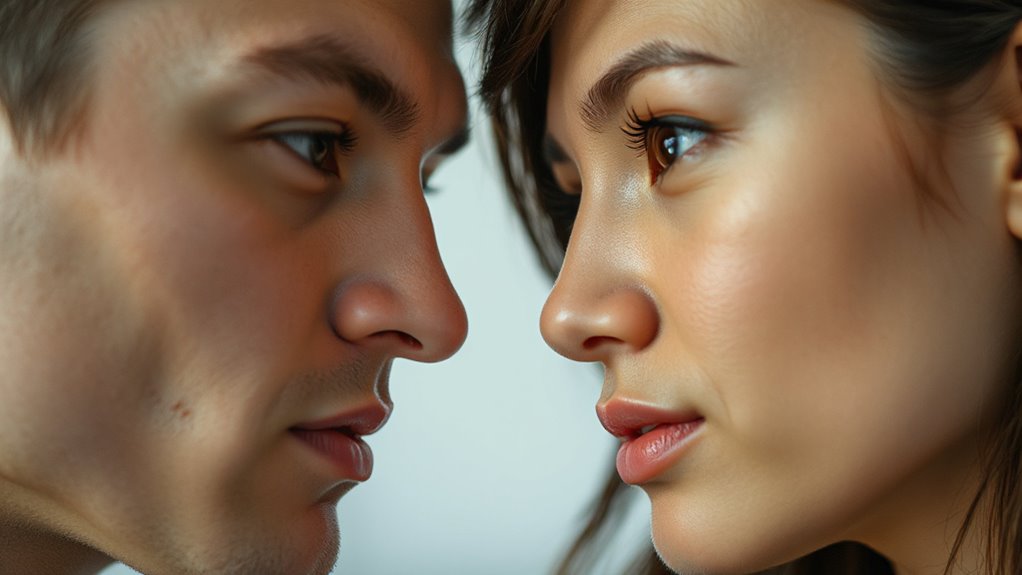
Attraction operates on autopilot, driven by neurochemical circuits and sensory signals that fire long before conscious choice enters the picture.
Attraction fires through neurochemical pathways before conscious thought kicks in—the body decides while the mind believes it’s choosing.
When people meet someone they find attractive, dopamine, norepinephrine, and cortisol flood the nucleus accumbens and ventral tegmental area.
Sexual craving runs on testosterone and estrogen through the amygdala.
This isn’t poetry—it’s biology running the show while everyone thinks they’re making rational decisions.
The body releases pheromones and chemosignals that others detect unconsciously.
Every person carries a unique odor profile determined by their HLA gene complexes, functioning like fingerprints.
Research shows couples tend to have dissimilar MCH genes, meaning people gravitate toward genetic diversity without realizing it.
In studies, synthetic sex-attractant pheromones measurably increased sexual intercourse, sleeping next to partners, formal dates, and affectionate behaviors.
The nose knows before the brain catches up.
Most assume attraction boils down to looks, but the data paints a different picture.
Audio-video stimuli rated highest across modalities tested, while body odors alone rated lowest.
Voice and appearance showed positive associations in attractiveness ratings, meaning multiple sensory channels matter simultaneously.
BMI and waist-to-hip ratio serve as critical physical cues, but skin quality and body proportions matter too.
Attraction extends beyond opposite-sex contexts into same-sex environments, following similar patterns.
Prolonged eye contact between strangers markedly increased romantic attraction in experimental settings, raising blood pressure and motivating future interactions.
Mutual touch, especially hand-holding, produced even stronger effects than eye contact alone.
Repeated exposure creates comfort and trust through the mere exposure effect—people grow to like those they encounter regularly, even without romantic context.
Here’s what trips most people up: they believe universal standards dictate attraction.
Personal preferences account for substantial variance alongside broader patterns.
Distinct neural circuits for lust, attachment, and attraction operate independently in non-monogamous species but feed on and reinforce each other in monogamous ones.
Facial features like averageness, sex-typicality, and symmetry correlate with attractiveness ratings across cultures, yet the strength of these associations varies considerably by perceiver.
The mechanics aren’t simple, and anyone claiming one-size-fits-all rules is selling something.
Attraction combines hardwired biology with individual variation, running deeper than surface-level theories suggest.
Love deactivates brain regions that mediate critical social assessment, stripping away the usual filters that evaluate new people.
Familiarity and shared core values, not just shared hobbies, are key to forming lasting bonds through the processes of repeated contact and shared values.