



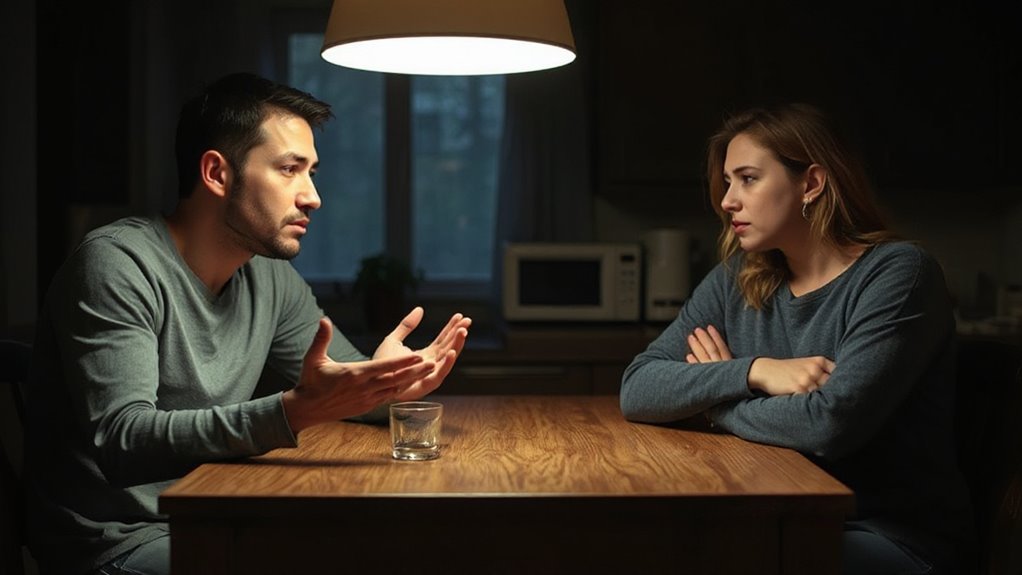
Why Disrespect Feels So Personal During Marital Conflict?
Disrespect cuts deep in marriage—deeper than most people expect. Why? Because marriage is supposed to be the one safe place. When that safety gets violated, it stings differently than any outside insult could.
Research backs this up hard. Eighty-three percent of husbands report feeling disrespected during conflict. Seventy-two percent of wives feel unloved. These aren’t small numbers. They’re an epidemic hiding behind closed doors. Trust problems often follow, since 77% carry baggage from past relationships into new ones, making recovery harder.
And here’s the kicker—both reactions feed each other. A wife feeling unloved acts dismissive. A husband feeling disrespected withdraws or explodes. Nobody wins. Disrespect in marriage feels personal because it *is* personal. According to Shaunti Feldhahn’s research, a husband’s anger during conflict is often less about rage and more about feeling disrespected.
Experts warn that patterns of contempt and criticism are among the most damaging forces in a marriage, significantly increasing the likelihood of marriage decline over time.
Why You Keep Hurting Each Other: and How to Break the Pattern
The same fight keeps happening. Different day, same wounds. That’s not a coincidence—it’s a cycle.
Same fight. Different day. If it keeps happening, it isn’t bad luck—it’s a pattern waiting to be broken.
One partner reacts, the other fires back, and suddenly nobody remembers what started it. Attachment injuries drive this. Old hurts from early in the relationship quietly shape how each partner reads behavior, usually negatively.
Contempt sneaks in. Defensiveness follows. Nobody’s actually listening—they’re just reloading.
The pattern won’t break by winning arguments. It breaks when both people stop interpreting everything as an attack and start asking actual questions. Curiosity beats assumption every time. Identify the original wound. That’s where the real work starts.
When inaccessible or unresponsive partners trigger attachment insecurity, the resulting distress can quietly poison every interaction that follows. Consistent, transparent behaviors over months are what most often rebuild safety, not quick fixes or promises, so prioritize consistent change in your approach.
How to Name Your Feelings Without Making Things Worse
Naming feelings sounds simple—until someone opens their mouth and it turns into an accusation wearing an emotion costume.
“I feel like you’re selfish” isn’t a feeling. It’s a verdict. Real emotional honesty sounds like, “I feel hurt when you make plans without telling me.” See the difference? One attacks character. The other names impact.
Labeling behavior—not the person—keeps emotional safety intact. Try starting with care: “I care about us, and I feel frustrated when…” Then ask for something specific. Clarity builds connection. Labels build walls. Pick one.
Therapists often recommend using the I feel, need, request formula to express emotions in a calm, blame-free way that keeps the conversation moving toward resolution rather than retaliation.
Research supports this approach—studies indicate that perspective-focused I-language reduces conflict escalation by helping partners communicate their emotional experience without triggering defensiveness in the other person.
Regularly acknowledging small efforts like making coffee or listening well can raise relationship satisfaction and support emotional safety, a change driven by the gratitude habit.
Say What You Need to Your Spouse Without Starting Another Argument
Knowing what to call a feeling is only half the battle. The harder part? Saying what you actually need without lighting the room on fire. Skip “you never listen” and try “I need a few minutes to finish my thought—can you just hear me out?” See the difference? One accuses. One requests. Vulnerability works better than ammunition.
Say “I miss feeling close to you” instead of “you’re always distant.” Use daily check-ins—ten minutes, two questions, no courtroom drama. Slowing the pace signals safety. And safe conversations? That’s where real needs finally get heard without triggering another unnecessary war. Attachment styles are learned and changeable, meaning the defensive patterns driving your conflicts are not permanent fixtures in your marriage. When conflict feels stuck and every conversation seems loaded, outside support from a therapist can help interrupt those entrenched patterns before they do lasting damage. Consider combining active listening with turn-taking to increase the chance of resolution by fostering clearer understanding and reducing escalation active listening.
How to Rebuild Trust After Marital Conflict Keeps Repeating
Repeating conflict doesn’t just wear people down—it quietly convinces both partners that change is impossible. But trust can rebuild, slowly, if both people actually do the work. The guilty partner owns the damage completely—no excuses, no blame-shifting, no minimizing. Then comes the harder part: consistency. Daily honesty. Follow-through on promises. Transparent devices, open communication, real accountability. The hurt partner needs patience honored, not rushed. Healing takes months, sometimes years. Sustained physical affection and presence during difficult conversations help restore emotional safety and connection, reinforcing emotional bonds.
When the cycle feels too entrenched, couples counseling isn’t optional—it’s necessary. Structured therapy addresses the deeper patterns. Want different results? Both people have to show up differently. Research on Emotionally Focused Therapy shows that roughly 70 to 75 percent of couples move from distress to recovery, with about 90 percent showing significant improvement.
Radical honesty—a commitment where nothing is off-limits, including uncomfortable or seemingly insignificant details—breaks down the hidden walls that keep mistrust alive long after the original wound.