

Why Dating Apps Aren’t Actually Built for Long-Term Relationships
Dating apps were not built to find someone a lifelong partner—they were built to keep someone on the app.
Dating apps were not engineered to find you love—they were engineered to make sure you keep looking.
Swipes, badges, and instant matches are engineered for engagement, not emotional depth.
The business model depends on users staying active and indecisive.
Relationships maturing offline? Bad for revenue.
Companies track daily users and time spent—not marriage rates or relationship satisfaction.
Profiles are designed for quick scrolling, not serious evaluation.
So users skim instead of assess.
It is a slot machine dressed as a matchmaker, and the house always wins. Less than 24% of dating app users ever find a long-term partner through the apps.
In fact, 46% of dating-app users describe their overall experience on these platforms as very or somewhat negative, according to the Pew Research Center.
Despite these flaws, 30% of U.S. adults now use online dating, signaling how normalized the practice has become.
Why Dating App Algorithms Don’t Predict Real Compatibility
The business model problem runs deeper than profit motives and shiny app design.
The algorithms themselves are broken.
A 2012 landmark review found zero compelling evidence that matching algorithms actually predict relationship success.
A 2017–2020 machine learning study using 100-plus variables predicted largely no unique compatibility between specific people.
One algorithm literally performed worse than random chance.
Why?
Because real chemistry cannot exist in a profile.
It only emerges after two people actually meet.
Apps cannot measure that.
So instead, they optimize for swipes and messages, not lasting relationships.
The math was never designed to find someone’s person.
A 2024 study across 43 countries with over 10,000 participants found that ideal-preference matching explained only a tiny fraction of romantic outcome variance.
Dating app algorithms are intellectual property, meaning scientists cannot independently verify or fact-check the specific formulas being used to match people.
Long-distance relationships often require trust as foundation and deliberate effort to succeed.
How Endless Options Make It Harder to Commit to Anyone
On top of broken algorithms, there is another problem quietly wrecking people’s chances at real commitment: too many options. Barry Schwartz called it the paradox of choice—more options, less satisfaction. Dating apps weaponize this daily.
- The brain stays in “keep looking” mode, never settling because something better feels one swipe away.
- Decision fatigue is real—swiping through endless profiles drains the emotional energy needed to actually invest in someone. This constant scrolling also undermines the timely follow-up and sustained attention needed to move from a first date to a second one.
- Everyone starts feeling replaceable, which destroys the sense of stability commitment actually requires.
Research consistently shows that sustained emotional attention is a prerequisite for building intimacy, yet the constant pull of available alternatives redirects that attention toward browsing rather than bonding.
Cross-national research spanning 6,646 individuals across 50 countries found that online-origin relationships reported lower relationship satisfaction and less intense love than those that began face-to-face.
More choices should feel empowering. Instead, they just make everyone feel disposable.
How Dating Apps Are Designed to Damage Your Confidence
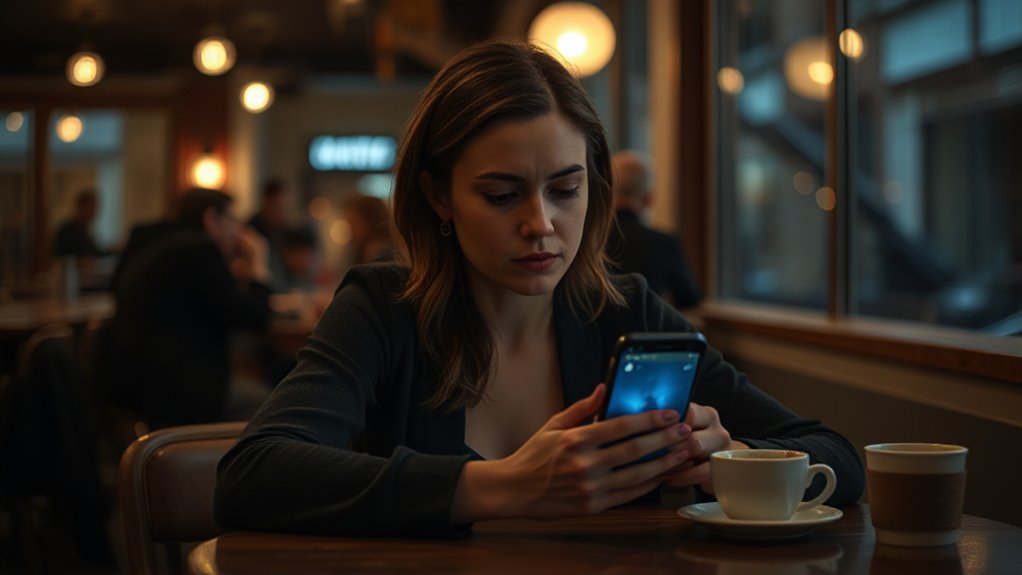
Swipe enough times, and something quietly breaks.
Dating apps are engineered around constant visual judgment—rapid photo scanning, binary like/dislike mechanics, endless profile comparisons.
Swipe. Judge. Repeat. Dating apps aren’t matchmakers—they’re sorting machines built on looks-first, binary decisions.
That design isn’t neutral.
Research links Tinder use directly to lower self-esteem, worse body image, and higher anxiety than non-users. Nonverbal cues often get lost in app interactions, removing subtle signals that help people gauge interest in person.
Every swipe reinforces the feeling of being rated like a product.
Users constantly compare themselves to curated, idealized profiles, which triggers upward social comparison—and upward social comparison reliably makes people feel inadequate.
Add routine ghosting and non-responses, and the damage compounds.
The app isn’t broken.
It’s working exactly as designed.
Users are just collateral damage.
The average Tinder user logged in 11 times a day, two years after launch—not because the app was delivering meaningful connection, but because its slot-machine mechanics kept pulling them back.
Some users have walked away entirely, with 20-year-old Finn Joseph quitting Tinder after finding that judgment on appearance caused him to value his own personality traits less and less.
Why Dating Apps Make It So Easy to Lie
Dating apps don’t just tolerate lying—they practically invite it. No face-to-face pressure. No real-time accountability. Just a screen, some photos, and a text box begging to be optimized. Research shows up to 80% of online daters lie to some extent. That’s not a few bad apples—that’s the orchard.
Here’s what’s fueling it:
- Anonymity removes consequences — Nobody’s watching, so exaggeration feels harmless.
- Edited messaging replaces spontaneity — Users rehearse answers, hiding inconvenient truths.
- Appearance pressure drives distortion — Women lie about weight; men lie about height. Almost reflexively.
The platform design rewards the polished version, not the real one. Survey data found that one in five respondents admitted to lying specifically to secure sex, with the most dangerous fabrications centering on relationship availability and romantic intentions rather than physical traits. Beyond vanity and desire, fear also drives deception—34% of female users intentionally falsify personal information to protect themselves from extortionists and con men who exploit the vulnerabilities of online dating. Many users, however, try to protect themselves by taking precautions such as meeting in public and keeping conversations on the app at first.